
South Wales
Client: Bengal Dragons Foundation
Bengal Dragons Foundation (BDF), is a community organisation based in South Wales that has established a community-owned renewable energy initiative that aims to provide the South Asian community with a more sustainable future by reducing carbon emissions and energy costs in community buildings, through energy saving measures and on-site power generation and storage solutions.
BDF contacted YnNi Teg to find out how they could address the impact of the climate crisis and high energy costs within the South Asian community in Wales. This led to a pilot project in partnership with the Welsh Government Energy Service looking at 10 buildings that are both places of worship and local community centres, undertaking a series of assessments of energy efficiency and potential for solar PV and other renewables.
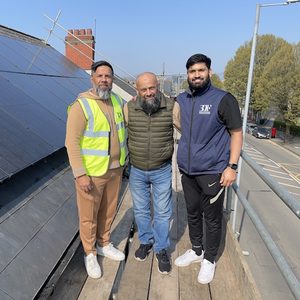
Phase 1 of the project, between 2024 and 2025, saw the installation of solar PV and battery storage systems at seven mosques across South Wales.
The first phase created 0.22 megawatts (MW) of renewable energy capacity and is forecast to save 335 tonnes of CO2e over its lifetime with some communities benefiting from electric vehicle charging points, solar-linked controllers for hot water tanks, and infrared heaters.
Phase two had the objective of extending the Gwyrdd Bangla project to a site in North and West Wales. The project has since found a suitable host in the Wrexham area and completed an installation of a domestic hot water heat pump, along with EV charging in early 2026.
The project is actively seeking new partners, funders, and community sites who share the vision for faith-driven climate action and to explore innovative energy solutions together. If your mosque or organisation would like to be involved, we would love to hear from you.
Case study
One of our participating mosques noted that, for the sunny months of May-July 2025, compared to the same period in 2023, it cut its electricity import by 83% saving £1,380. Assuming that the electricity it didn’t import was generated by the solar panels, that was equivalent to powering 6,000 5-minute showers. The reduction in carbon emissions was equal to that emitted by driving 4,200 miles in a petrol car.